De vez en cuando intentaré escribir en español. El siguiente es un artículo que ya publiqué en inglés (https://mhcelebrant.scot/what-is-grief) y que traduje al español con las útiles sugerencias de mi amiga y colega Gina Tarditi Ruiz.
From time to time I will try to write pieces in Spanish. The following is a piece that I already posted in English (https://mhcelebrant.scot/what-is-grief) and which I translated to Spanish with helpful suggestions from my friend and colleague Gina Tarditi Ruiz.
¿Qué es el duelo?
¿Es un líquido, una fuerza, una carga? ¿Podemos medirlo, verterlo en frascos, almacenarlo, dividirlo, repartirlo…tanto para la madre, tanto para el padre?
¿Podemos agotarlo, poco a poco, por anticipado? ¿Guardarlo para más tarde? ¿Deshacernos de él?
¿Lo bebemos sorbo a sorbo como a un buen whisky añejo, lo bebemos todo en un solo trago, o nos ahogamos sin esperanza en sus profundidades?
O ¿es el duelo un viaje? Hoy vivimos todo como si fuera un viaje: aprender el japonés; adiestrar una mascota; el cáncer. Y si es un viaje, ¿existe un mapa? Yo hice el Camino de Santiago una vez, de Francia hasta el borde occidental de España. El primer día conocí a una mujer que había cruzado el Atlántico para reparar un corazón roto. Mientras nos preparábamos para partir me preguntó: “¿crees que podría llevar chanclas?” Nunca la volví a ver.
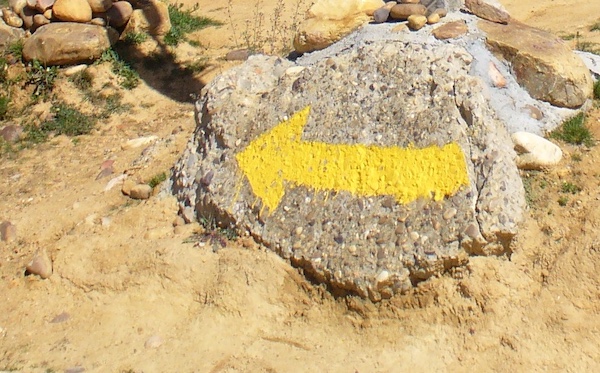
Dos días después dejé mi mapa en algún lugar y me creí perdido, pero descubrí que, a lo largo del sendero, desgastado por los siglos, había flechas amarillas en cada curva. Y cuando por fin entré en Santiago, recibí el sello de la Catedral, me quedé en un hotel, y luego me fui al aeropuerto. Mi camino había terminado y yo estaba listo para volver a casa. Y entonces pensé en aquellos peregrinos medievales que llegaron a esa misma ciudad, por el mismo camino de las flechas amarillas, sabiendo que solo habían recorrido la mitad.
O ¿es el duelo un animal salvaje? ¿Un lobo que aúlla, un escorpión que pica, un elefante macho enfurecido? O ¿es una pantera que espera con paciencia infinita para abalanzarse sobre el cordero desprevenido?
O ¿Es el duelo un aliado, un viejo amigo, cuya cada palabra resulta familiar y conocida? O ¿es un compañero engañoso que nos envuelve en frases azucaradas para después hundir su cuchillo entre nuestras costillas. O ¿es, tal vez, un borracho roto sentado al bar, que medio recuerda las cosas medio olvidadas?
¿Es el duelo una ducha fría y vigorizante que nos vendrá bien? ¿Nos ayudará crecer? O ¿es como una migraña que atormenta la mente y acaba con nuestra fuerza y determinación?
¿Podemos siquiera entender qué es el duelo: de antemano, mientras lo estamos afrontando o después, cuando se haya apaciguado?
O, simplemente hacemos lo de siempre, dormir cuando podemos, despertar cada día intentando seguir las flechas amarillas adondequiera que nos lleven; adondequiera que apunten.
Tal vez esto es cuanto podemos hacer con el duelo.
“Döstädning is a simple living practice that encourages people to get rid of belongings before death to spare loved ones from having to manage them”, The Gentle Art of Swedish Death Cleaning by Margareta Magnusson
I’m not exactly a domestic goddess. In fact I incline to the philosophy of Quentin Crisp who famously had a message of hope in 1968 for the housewives of England: “Hold your nerve,” he urged, “after the first four years, the dirt doesn’t get any worse.”
But even I find myself forced to tackle the chaos and rampant entropy that I always seem to inhabit. Picture me then, lemon multi-surface cleaner in hand, hair swept up beneath an Hermès turban, grimly purposeful in a Joan Crawford housecoat. “I’m not mad at you” I say (madly) at the slovenly alter-Michael, “I’m mad at the dirt!”
And this time I’m really going to town. Because I felt that I needed to go further than just a deep clean. This is a proper clear out.
My mother moved into this house in 1971 and over the course of more than half a century a lot of stuff has accumulated. Now, unlike me, my mother is a tidy person who kept the house spick and span when she was able. But she likes nice things – in the kitchen where I’m starting there is a lot of china, far more bowls, jugs, plates than we could ever use. I’ve counted four frying pans, ten regular saucepans of every size, an astonishing number of sieves. And tins with dubious sell-by dates. And drawer after drawer of things that have “seen better days”. The whole house has “seen better days” to be frank.
I see this task as a preparation, of course, for when I have to clear the house to sell it. I tell myself I’m making it easy for when that inevitable but indeterminate date arrives. It’s a sort of döstädning: I’m gently death cleaning on my mother’s behalf now that she has no mobility and ever weaker short-term memory.
Döstädning. It is a very Scandinavian concept. And I’m unsurprised to read that there is a Japanese equivalent, shukatsu. In my mind’s eye I see an already very minimalist (yet comfortingly hyggelig) house, wooden perhaps, and painted sky blue. A lot of elegant rugs and a single exquisite Danish sideboard. Some hand dipped ramen bowls. In truth, not really a lot of clutter to begin with. And the one cracked bowl is a candidate for kintsugi rather than cowp*.
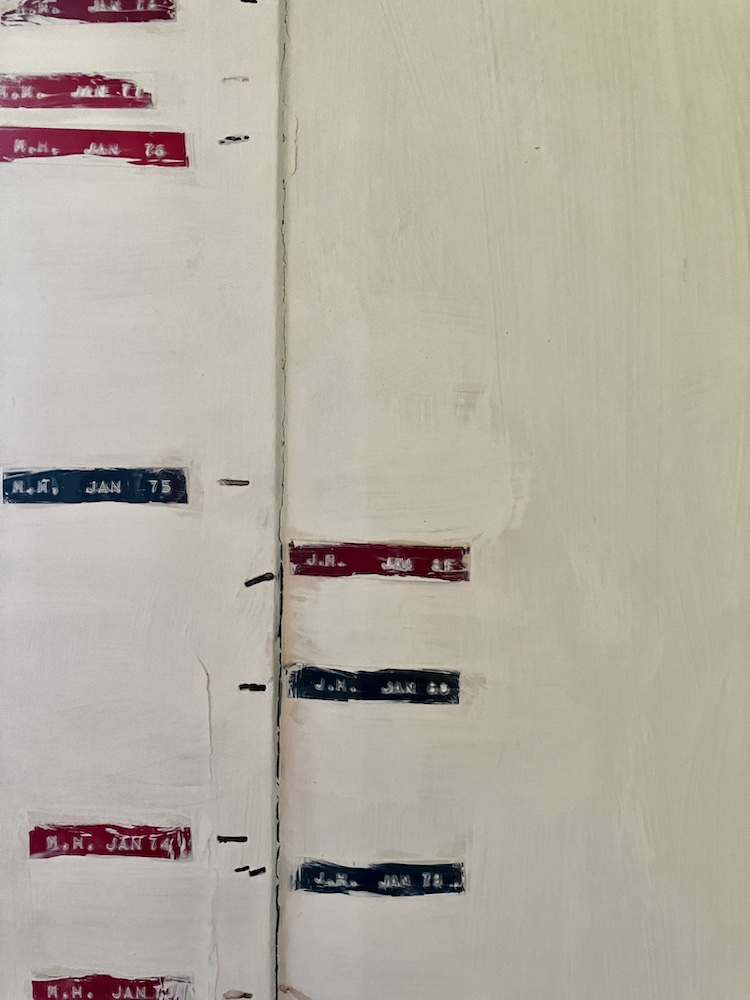
But here among the genuine clutter of a life coming to an end, I find things are not as gentle as the writers of self-help books might suggest. The dymo plastic labels my dad printed and stuck to the pantry door to indicate our heights as children: M.H. Jan 74. A pot of raspberry jam – perhaps the last my mother made, now inedible and changed from ruby to topaz because I couldn’t ever quite bear to open it. And a set of faded blue plastic pastry cutters bought in the 1960s (actually, maybe the 50s) and used for innumerable scones.
Grief has its unexpected triggers. And so does anticipatory grief. I will chuck the jam and the cracked china jugs and the broken steamer. I will make up a box of things for the charity shops including the teapot that may never actually have been used and most of those metal sieves. But somehow the pastry cutters found their way back into a drawer.
‘Everyone has the right to make their own decisions’ (Talking Mats training materials).
‘To deny people their human rights is to challenge their very humanity’ (Nelson Mandela).
Talking about death and funeral planning is challenging and emotional for all of us.
As an Interfaith Celebrant with a background in Special Education, I am very aware that often, people with additional support needs are not given the opportunity to have this conversation, either to plan their own funeral, or to be involved in planning a service for someone close. Frequently, this comes from a concern to protect individuals from grief and loss, and from the distress of contemplating their own death.
However, the impact of preventing this involvement can be significant: the grieving process includes being able to say ‘goodbye’, and being able to participate in, or indeed, to plan, ceremonies and services. Knowing the wishes of our loved ones is so helpful at a time of grief, and it is important that everyone is given the opportunity to have their voice heard, and to be supported to give their views.
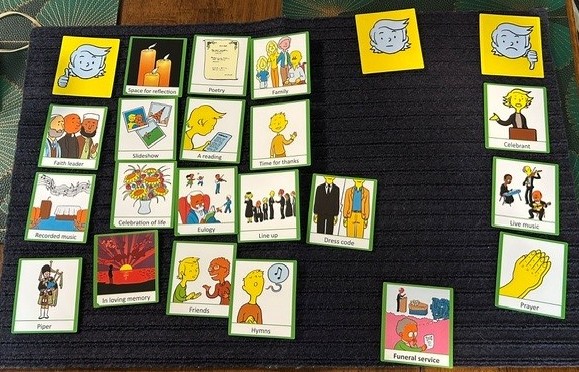
Following my experience of using Talking Mats in a special school setting, I worked with Talking Mats colleagues and other celebrants to develop a Funeral Planning set. This was launched in 2024 and consists of 3 conversations:
Funeral Planning – an introductory conversation between an individual and a funeral director, minister or celebrant, to discuss what someone wants or does not want for their funeral.
Funeral Service – a more detailed conversation regarding choices about the actual service.
Eulogy – a conversation which highlights the important themes that someone would want included in their eulogy.
The group had taken part in an amazing project, ‘My Wishes, Please Respect Them’, discussing many aspects of death and dying, and I went along to a final group session to explain the Talking Mats Funeral Resource.
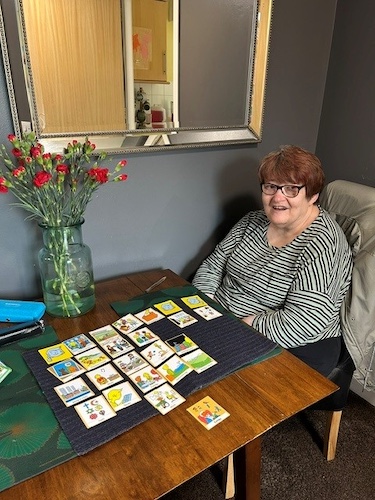
Eleven members of the group expressed an interest in planning their own funeral service, using Talking Mats. I met with each person; had the three conversations above, took notes and gave everyone their own booklet with a photo of each Talking Mat and a summary of the notes I had taken.
Grateful thanks to Caitlin for giving her permission to use this photograph.
The age range was from around 35 to around 70, and everyone had different levels of understanding. What was remarkable, was the consistency of everyone’s willingness to have these conversations, demonstrating such courage and openness to talk about their own funeral services. Everyone had a member of their support staff with them: they were all excellent at supporting, only intervening when necessary, and often providing valuable information.
Reflecting on the whole experience leaves me with such a positive sense of the importance of these conversations, and of making sure that support is available to ensure that more people can have them – to ensure that everyone had the right to make their own decisions.
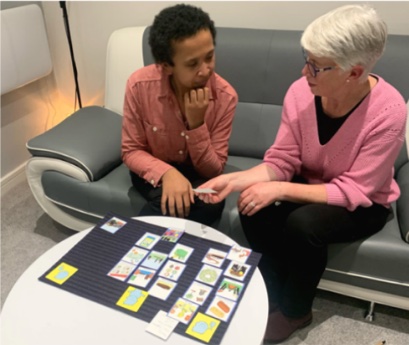
The process of a Talking Mats conversation lends itself so well to funeral planning. As the person guiding the conversation, I am the ‘Listener’ and the person making choices is the ‘Thinker’.
Never an easy conversation, rather than talking across a table, we sit side by side, relaxed, the focus on the mat, with open questions and choices being made by the ‘Thinker’ placing the picture card on the mat (for example, what I really want, what I really don’t want, and what I’m not sure about, for my funeral). The pace of the conversation is guided by the ‘Thinker’ with the ‘Listener’ allowing as much time as is needed for choices to be made, and then checking again, if there are any changes to be made.
At the end of the conversation, I took a photograph of the mat, and so was able to ‘record’ wishes which I then included in a booklet.
This is an example of a completed Funeral Service Talking Mat.
And so, to the conversations themselves. Everyone was at a slightly different stage in thinking about their funerals. Some were very clear about what they wanted: sunflowers, Egyptian cotton to line their coffin, pipes and drums, favourite songs and poems (including ‘Anyone for Tennis’ by Eric Bult). Others were at the early stages of thinking about their services, and the conversations were probably most helpful in deciding what they didn’t want, and stimulating some thoughts on choices around cremations, burials, church services or celebrant-led funerals.
In spite of different levels of understanding, I felt that everyone was clear about the topic and glad to have the conversations, but some responses gave me pause for thought. There was only one person who, initially, was quite hesitant, and appeared to be a bit upset. However, once we were under way, the conversation became easier (talking about favourite music is so helpful!), and I checked regularly that we were OK to continue.
Someone asked me, ‘when will my funeral be?’, I, of course, responded, ‘oh, not for ages!’. This did make me question how we hold conversations about funeral planning, knowing that this person will not be there? But, surely, the only way to plan, is to envisage that they WILL be there, imagining the place, the people, the music etc. and, there’s nothing wrong with that!
In one conversation, I was a bit concerned that, when we recapped and I checked that a piper was indeed wanted, my ‘Thinker’ was just delighted, and my feeling was that he thought that I had just booked one!
Explanations about the difference between a cremation and a burial, a Church and a celebrant-led service, a religious and non-religious service were necessary, and I suggested that visits to a crematorium and to a funeral parlour could help to dispel some of the anxieties that are around not knowing what happens in these places. I very much believe that organising such visits, possibly with friends, create the opportunities to ask questions in a safe and supportive environment, and can lead to wider and easier conversations about death. This is something that is very much encouraged by ‘The D Word’ – a resource that I and some other celebrants have developed for school and community groups.
Any visits that we have organised and facilitated have been very valuable and crematorium staff and funeral directors have always been very welcoming.
When I asked one of my ‘Thinkers’ what they thought of the three conversations, her response was ‘that was fun!’. There is such value in spending time with people, giving them your undivided attention, listening deeply to them, talking about something so special and individual. To know that a conversation about funeral planning could ever be ‘fun’ is quite something, and very rewarding!
For some, their choice was for a Church service, led by a minister, however, in most cases, there wasn’t actually a Church connection, or a minister who would know them.
This is Brenda with her ‘Eulogy’ Talking Mat. Brenda kindly gave her permission for this photograph to be shared.
Speaking with some of the support staff, we discussed the strong possibility that some responses were influenced, either by the perception the ‘Thinker’ had of what the ‘right’ response should be, and/or by their perception of family expectations. This is a challenge: Talking Mats give people the opportunity to express their views, and, in this case their choices and preferences, and there is no way of knowing whether other factors might influence these responses.
It could be that repeating this conversation sometime in the future would result in different choices. The importance of valuing the ‘Thinkers’’ responses is vital. It is also of the utmost importance to remember that the ‘Listener’ is not there to judge in any way at all. This could also be a challenge if choices could incur a significant cost …
I gave each person their booklet with the record of their wishes for their funerals. This (and an electronic copy) will be kept by Key but could also be shared with Legal Guardians. When the time comes, these documents can be shared with funeral directors/arrangers and Ministers/Celebrants, and decisions about the best way to fulfil the wishes of the person who has died will be taken then.
Knowing these wishes (whether or not they can be fully implemented), goes a long way to easing the challenges of dealing with the grief of loss and making decisions at such a sad time.
This is equally valuable if there are no close family members, and support staff from Key are involved in planning a funeral for someone they have supported.
I am very grateful to everyone in Key for giving me this opportunity – I found the whole experience so valuable, interesting and rewarding. I learned such a lot, and so enjoyed spending time with everyone – thank you all!
I always like when families request a poem to be read at a funeral. A poem can sum up a person or an emotion in just a few words. Sometimes, as in Lonely Funerals, where the person we are honouring may have had few or no friends, relatives, connections, there is very little information – yet a poem can make an eloquent statement.
Of course many people don’t care for poetry and there’s no point choosing something simply for the sake of it. The last thing you want to do as a celebrant is give families extra stress by encouraging them to look for something that will “sum up” their person when neither they nor that person had the slightest interest in poems.
But there’s no doubt that poems are powerful and, when well read, they can set a tone or can pull memories and biography together. Well known funeral poems are chosen precisely because they put into words the feelings of the mourners. “Do not stand at my gave and weep”…. “An honest man here lies at rest”…”Do not go gentle into that good night”.
Maybe the person had a favourite poet. Mary Oliver or Yeats or Rumi…. Or a search on the internet for “funeral poems for mothers…. fathers … sisters”, whatever is appropriate, will bring up lots of options.
And these days, people use AI to generate poems. I’m wary of AI but this seems a perfect use of the technology. A family member gathers information about the person, details of their personality, their likes and loves. And AI creates a poem: that is, AI writes text with poetic order and style … but, to me, these are really written by the family member.
This week I had another fascinating example of a poem created by a family member. They had used a simple prompt “You were….” started every verse with those words and then given an example of that person’s life and character. Here are just a few examples:
You were swimming in the sea, dressed crabs at Crail and awful bright red speedos!
You were so funny, quick-witted and sharp as a tack.
You were board games, snakes and ladders, Grandpa’s shop, hide-and-seek, bubbles and ice cream in the garden.
You were our anchor.
You were Our Dad.
No need to rhyme, or worry about rhythm or metaphor. No need to make the verses equal in length or follow some chronological order. Just a series of heartfelt observations and memories that so vividly evoked this man. And something that any family could do. Perhaps each member writing a line or two in a way that allows people to feel they have really contributed to, and participated in, the funeral.
This particular poem was read at a natural burial. I then read a eulogy. It’s always risky having a eulogy at an outdoor burial because the Scottish weather can be unforgiving. In the event we were lucky, the threat of rain didn’t materialize. But if the heavens had opened, I would have had to cut things short. In this case perhaps just reading the poem, leaving the eulogy till the tea. And while that wouldn’t have been ideal, the power of these words would have made it a fitting and perfect tribute in itself.
[Thanks to V for permission to quote from “You Were…”. I am dedicating this post in memory of your beloved dad, C]
Is it a liquid, a force, a charge? Can we measure it, pour it into jars, store it, divide it, apportion it? This much for mother and that much for dad.
Can we use it up in advance? Save it for later? Pour it all away?
Do we sip it like a fine old malt, down it in one, or drown hopelessly in its depths?
Or is grief a journey? Everything is a journey these days: learning Spanish; pet training; cancer. And if it’s a journey, is there a map? I walked the Camino de Santiago once, from France to the western edge of Spain. On the first day I met a woman from America who had crossed the Atlantic to mend a broken heart. As we prepared to set out, she asked me “do you think I could wear flip flops?” …. I never saw her again.
Two days later I left my map somewhere and I thought I was lost. But at every turn and fork there were yellow arrows, a path well worn for centuries. And when at last I walked into Santiago, I got my stamp from the Cathedral, stayed in a hotel and made my way to the airport, finished and ready to go home. And then I thought of those medieval pilgrims who reached that same city on that same path of yellow arrows, knowing they were only half-way done.
Or is grief a wild animal? A wolf that howls, a scorpion that stings, a mad bull elephant? Or a panther that waits with infinite patience to pounce on the unsuspecting lamb?
Is grief an ally, a comfortable old friend whose every word is familiar and known? Or a duplicitous companion spinning sugared phrases one moment, only to slide a knife between our ribs the next? Or a broken drunk at the bar half remembering half-forgotten memories?
Is grief a bracing cold shower that will do us good, make us strong and help us grow? Or a mind-grinding migraine that saps our strength and resolve?
Can we even know what it is: in advance, in its midst, or after it subsides?
Or do we just do what we always do, what we always did? Sleep when we can, wake up, start the day and try our best to follow the yellow arrows, wherever they take take us, wherever they point.
I am a member of the group Open Beliefs Scotland (OBS). One important strand of OBS work is acting as an NRS-accredited “belief body”. This means that OBS wedding celebrants can legally marry people under Scots law.
Of course I’m not a wedding celebrant – I mainly focus on funerals, end of life ceremonies and ecological grief work. But the work of these belief bodies goes beyond simply acting as the registration vehicle for legal marriages. In OBS’s case, the group runs a series of semi-public talks and discussions on issues of interest to the celebrant community and a wider audience.
Last night we were discussing “spirituality”. Laura Gordon opened by noting that at the coronation of the new king, various religions were represented as well as (and this was seen as innovative) Humanists. But what, she wondered, about all the people who fall somewhere in between?
The people who are so familiar to celebrants. The people who are not members of any religion and who want a service that is essentially non-religious….but maybe includes a favourite hymn or prayer. Or a reading from scripture. Or, most commonly of all, some words that recognize that their loved one is still in some way “there” and maybe even “reunited” with a spouse.
Because most people, even if they’ve never set foot in a church (or temple, or mosque…), hold some beliefs and ideas about the afterlife, the transcendent, about there being “something more” or “something bigger and beyond the everyday”.
Such ideas are rarely part of a fully worked out metaphysical view of reality. Just a sense in most of us that there is more to this life than we can easily perceive. And this is where the word “spirituality” can be useful. When I was studying for my masters dissertation on the growth of celebrancy in Scotland, I examined this concept. And it was clear to me that the word gets used in different ways all the time. I found an academic analysis of how it is defined in healthcare literature. The authors found that in 27 different studies, there were essentially 27 different definitions! It can be used in a traditional religious sense, or used in neuroscience literature, or deployed to sell scented candles…
But maybe this very ambiguity is actually useful to describe experiences and feelings that are otherwise hard to articulate. A case of “knowing what we mean” even if we can’t fully explain or describe.
From an OBS and independent celebrant (SICA) point of view, we wondered if it was helpful to set out a more positive case for “acknowledging spirituality” rather than simply defining ourselves in terms of what we are not. Being able to embrace and celebrate different spiritual traditions and elements or performing ceremonies that are totally religion-free, but always in alignment with the families and couples we work with.
Typical cases include among others:
couples whose families belong to different traditions
people who do not belong to any religion but want explicitly to make reference to an afterlife or “something bigger” – typically they may want us to state that spouses separated by death are now reunited
people whose identity (eg LGBTQ people) causes estrangement from their religion but who still believe in the core values of their faith
people who are active members of a given religion but who know that their tradition will not allow for the kind of person-centred ceremony that a celebrant can craft
people who have no religious faith but who appreciate the solemnity and wisdom of scriptural passages (“To every thing there is a season…”) or a childhood hymn
Thanks to Laura and Susan Fraser for organizing and leading a stimulating and thoughtful discussion.
This is a very short post because it’s just to acknowledge a really interesting piece on ecological grief by Megan Mayhew Bergman in The Guardian.
Seeing this in a major media outlet inspired me to make some changes to my own website to highlight the role of ceremony in ecological or climate grief. I think that celebrants have an important part to play in making this more common and more accessible. I rewrote my web page on this strand of my work and I’m always keen to collaborate with other celebrants and ceremony makers in Scotland or further afield.
Don’t hesitate to contact me if you’d like to chat about ways to mark environmental losses.
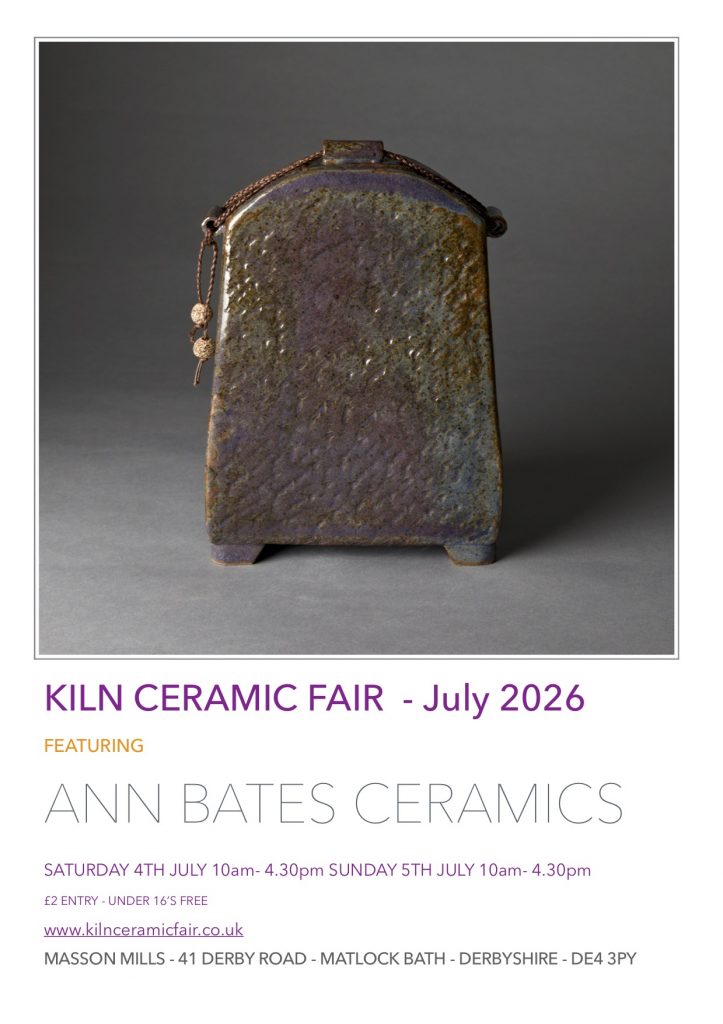
I’ve been thinking a lot about long farewells recently and about the things we do after a funeral to keep memories alive. After my own dad died we eventually received a plastic container with his ashes. We thought long about what we wanted to do with this and decided to commission an urn from a ceramics artist called Ann Bates.
The whole process of commissioning the urn was really helpful for me to feel we were doing something that dad would himself have like – he enjoyed a “project”. I’ve still got on my desk a couple of pieces of ceramic that Ann sent us to check on colours and designs. She was able to make it almost into a sort of little ceramic elegy for my seafarer dad. Colours drawn from the ocean, patterns of waves, and inside the lid (and now forever hidden) a little star map.
By strange coincidence Ann was in touch this week and she mentioned that she is exhibiting at a Fair in July. Details in the poster – it’s in Derbyshire so if you’re in the area you might like to drop in.
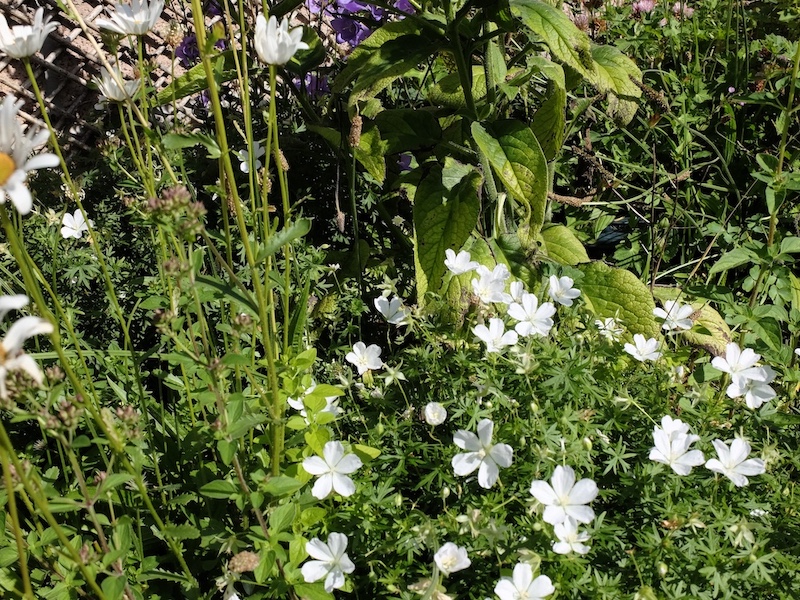
Dad’s urn is still in the garden – I’ve attached a photo and it is (just) visible among the flowers in a rather wild corner. A couple of years ago an adjacent wall had to be replaced and the whole patch was completely trampled and seemed to be ruined – just bare earth. But the white geraniums recovered and life returned and this year it is more lush than ever.
Good luck with the Fair, Ann and thanks again for your work on dad’s urn.
As a carer for my mum I am eligible for respite care.
Of course, I get a lot of support all the time. We have a care package that means that professional carers come in four times a day and once at night. They see to mum’s personal care and move her from bed to chair and back again – she can no longer walk herself at all.
But I still have to see to meals and drugs and groceries and laundry. And mum now gets very anxious when I leave the house even just for an hour. So, in turn, I get anxious.
I hadn’t ever really imagined that this would be my life at 66. It just seemed to happen. And I can’t claim that it involves huge amounts of physically demanding labour because it doesn’t. But gradually, as mum’s independence has seeped away, I have found myself less and less able to plan anything. Spontaneity has been replaced by a sort of stasis where I spend far too long at a screen not really doing anything, yet feeling unable to break away. And this is complicated by the very real presence of what we could call “anticipatory grief”. That’s a rather academic term but anyone who has cared for someone at end of life or with dementia will recognize it. A sense of already losing someone even though they are still physically present. As a celebrant I know the importance of the funeral ceremony in providing a clear focus for grief. But this anticipatory grief just seems an endless background sorrow, lacking the definition of a clear loss. And I find myself feeling guilt that I might be “using up” or expending my grief “too soon”. It lends a different meaning to the phrase “the long farewell” that I recently wrote about.
So I value those opportunities for respite even if they only make the return harder. This time I went to see friends in London and Dumfries and Glasgow. I went to a wonderful exhibition of Zurbarán at the National Gallery. Had some lovely meals (thank you Arfan, Sebastian, Helen, Adam, Marian, Justin, Aileen – and for almost having prosecco, to Carrie and Jane!). Caught up with my dear friend and colleague Gina Tarditi Ruiz from End of Life Studies days at Glasgow University.
At one point I sat on Dumfries railway station waiting for the Glasgow train. And I recalled a family holiday that I’d spent as a boy in Dumfries. Actually, I don’t remember very much about it. I know that we stayed in a house belonging to the daughter of a neighbour. I remember the garden wall overlooked fields and that cows would come right up to the wall to greet us. I know my mother was there but my seafarer dad was probably away at the time. I don’t know how we travelled there but we didn’t have a car so I imagine we came by train from Falkirk.
A young woman, a sailor’s wife but effectively a single-parent most of the time. It can’t have been much of a respite for her to travel with two children to Dumfries, swapping one house and the cooking and chores for another. And she had me, a young boy, and my infant sister, totally reliant on her.
Things come full circle, don’t they? Now at 91 it’s mum who is totally reliant on me, my sister, our carers.
It would be dishonest to say that such thoughts comfort me or “make it all worthwhile”. But I suppose at least they give me a context for this phase of my life. An appreciation of the reciprocity of care, sparked by the strange fleeting echo of a moment almost completely forgotten – a young woman sitting on a platform holding her luggage and her responsibilities, and waiting for the train to Glasgow.
I’ve just been chatting to one of my closest celebrant friends and colleagues, Gillian Robertson. Inevitably (as celebrants always do!) we got to discussing work and she told me of a service she had recently performed for a dear friend in the beautiful Fonab cemetery.
The service was actually an interment of ashes. Gillian had conducted the funeral and now she was performing this last act of ceremony. I know it will have been a very fitting and beautiful moment.
It got us thinking about ashes and what people choose to do with these last remains of their loved ones. There are creative ways to incorporate ash into memorial jewellery or all sorts of other objects that can bring great comfort (I wrote about Lynn Smith’s bears over a year ago). Sometimes people prefer to scatter the ashes in some special place. Or they inter the ashes, perhaps in an existing family lair – when my father’s cousin Betty died down south in Farnborough, I performed a service in the local crematorium but then, following her wishes, I carried the ashes back to Scotland, where we interred them in Camelon Cemetery. Reuniting her, the last of the Urquharts, with her parents and siblings.
Gillian and I wondered how many urns stand on shelves, maybe for years. Of course, this might be deliberate. People sometimes choose to wait, say, until a spouse dies so that the ashes can be mingled and scattered together.
But are there urns that sit there almost forgotten and simply because people don’t quite know what to do with them? That would be sad because these last ceremonies can be very special and meaningful. More private and less stressful than a funeral.
Celebrants are always taught that their work is so important and that they must strive for the highest standards of professionalism because the funeral is the last word. The final curtain. And you have to get it right. Well, I certainly think that celebrants should work to those high standards. And it would be odd for me to say that the funeral doesn’t matter….. but maybe it just doesn’t have to be that last word. Sometimes, for all sorts of reasons, a funeral isn’t the perfect send-off that people would have wanted. Think of COVID times. Or those funerals where emotion is so raw, grief so intense, after the sudden death of a young person. Or some terrible family rift opens. Or someone important can’t be there. When you consider the months of planning that go into weddings and then the short time you have to plan a funeral, it’s little wonder things don’t always work.
But I always think there are other opportunities. A celebration of life on an important anniversary. The dedication of a tree or a bench “in memory”. A family meal in a special place.
Or the loving burial of ashes in a beautiful Highland cemetery.
We agreed, Gillian and I, that it was a bit like music. There are pieces that end in quite a predictable fashion. There are songs that end suddenly. And, like the last Mahler song of the earth, there are pieces that just seem to gently linger and slowly fade.
I’ve been a member of the Scottish Independent Celebrants’ Association (SICA) for most of my celebrant career. I was elected to the committee a few years ago and helped revamp their website and then I spent two years as Chair. And one of the things that drew me to the organization was the word “independent”.
When SICA was first set up in 2011, the celebrant profession was quite new in Scotland. Up till then, most funerals were conducted by ministers or priests. Weddings were also mainly religious affairs or were registry office marriages with minimal ceremony.
But celebrants were beginning to appear. Some of those belonged to the Humanist societies. There had long been a tradition of totally secular funerals, although this was very much the minority. But Scotland was becoming a more secular society and so there was increasing demand for non-religious and person-centred ceremonies. Humanists catered to this trend. Their approach was always strictly atheist, with no mention of god or the afterlife, no prayers, no hymns.
But for many families, things were never so clear-cut. In my own experience, some families may consider themselves to be non-religious but might still believe that their loved ones are reunited and are living on in some way. Many people express a belief in spirituality even if they would never describe themselves as Christian or Moslem or any other “organized” religion. Some families have a blend of beliefs with some members atheist and others still church-going Christians.
Then there are cases when a family may still be church-going but prefer to have a celebrant conduct a funeral. Why? Because they want the funeral to be based on the life of their loved one. They want a eulogy, they want memories and anecdotes. And they know that a typical Mass for example, may barely mention the life of the person.
So the demand for celebrants increased, but just as these families didn’t want a rigid religious service, nor did they want a rigid Humanist approach. And this gap was filled by “independent celebrants”. Today the great majority of funerals are led by such independents even if they don’t always style themselves that way.
I was always drawn to this independent tradition and always wore the independent label with pride. Partly this is because I feel that it gives me greatest professional fulfilment to be able to tailor the work that I do to the wishes and values of the family and friends. And partly because I see myself as a bit of a independent minded person in general.
But SICA has had to confront a possible difficulty. Wedding celebrants are able under Scots law to marry two people…. but only if the celebrant is registered with a belief body accredited with the National Records of Scotland (NRS). For example, Agnostic Scotland or Open Beliefs Scotland (so, not necessarily religious). NRS considers these celebrants not to be “independent” …. because they are members of the belief body. But many of these celebrants are also members of SICA which is not a belief body but more of a professional association.
We’ve feared for some years that this causes potential conflicts for these celebrants. They need to say they are not independent because they are members of a belief group… but at the same time they are members of an association of independent celebrants!
The potential conflict has grown much sharper recently, partly because the number of wedding celebrants has increased a great deal, and partly because the NRS appears to be tightening up on its procedures. So what has always been a bit of a niggle for SICA threatened to become a full-blown crisis with the possibility that a large number of members would have to leave.
One answer to this problem would be to drop the word “independent”. Doing so would remove the problem at a stroke. But it would require a lot of work to update logos and branding and documents…. and more importantly it would dilute that sense of identity as independents.
To help resolve this, the new Chair, Diane McLeish, asked Stella McCulloch and me to conduct a consultation of the membership with a view to taking a final decision one way or the other. We were asked because neither of us is a wedding celebrant so we could remain impartial.
In parallel with the membership consultation we also tried to get some definitive answers from NRS. We understood their position but we wanted to ask specifically about dual membership given that SICA is a different type of organization. It took a lot of chasing … and patience, they are not an easy body to pin down! But in the end we managed to get the answers that we needed and were really pleased (and a little surprised) to learn that NRS saw no problem with dual membership of this kind. Suddenly (and at a stroke!) the need to change the name faded away.
I for one am really pleased that we remain Scottish independent celebrants and that I can continue to wear my independence with pride!
Last year I was asked by Full Circle Funeral Directors to lead one of their online information sessions. Although they are based in Leeds, Ilkley and Harrogate, I knew about their very extensive programme of seminars and I’d attended a few and chatted to David Billington, one of the funeral directors who organizes the online programme. He knew of my interest in assisted dying and he suggested I lead a sessionon this topic.
At the time, there was possible legislation progressing through four of our “local” parliaments: Scotland, Westminster, the Isle of Man Tynwald and the Jersey States Assembly, So it was a highly topical issue. I gave some background on definitions and on the places round the world where assisted dying is currently legal. I focused on two of those places, Oregon and the Netherlands, which illustrate two different approaches, especially on the question of eligibility.
Then I described the proposed legislation in the various “home” parliaments and gave a summary of where each was in terms of its legislative schedule.
There has since been quite a bit of parliamentary movement, so David asked if I would do a follow-up session last week. In fact the Bill in the Scottish Parliament has been defeated. The Westminster Bill has run out of time in the House of Lords (due to the huge number of amendments proposed in what has been seen as a deliberate wrecking tactic by some). The Bill in the Isle of Man has been approved but is still awaiting royal assent and seems to have encountered snags. Only Jersey appears to be moving ahead.
As the situation has largely stalled, I took some time to look at several “grey areas” where people in the UK do have access to forms of assisted dying or there is a certain ambiguity. For example, there is the Dignitas route where people can go to Switzerland to legally end their life. But of course they need to be physically able to make the journey, they need to have the funds to do it (over £10,000) and any friends or relatives who help them could in theory find themselves in legal jeopardy.
Then there is voluntarily stopping eating and drinking (VSED). I wrote recently about my reading of a memoir about this – Intervals by Marianne Brooker. I got the impression that some of the attendees at the session had not considered this possibility. Of course, ending your life in this way is not easy…. or quick.
In these sessions I try to avoid debate on “yes” or “no” to either the principle of assisted dying or on the specific legislation proposed. I also try to keep my own views to myself. I see the sessions as a way of informing people about the sheer complexity of the topic and and to highlight some of the moral issues. I draw on some first-hand experience from colleagues in Canada. And I try to open discussion to consider what impact such legislation might have on the work of funeral professions such as funeral directors, celebrants, end of life doulas, hospice workers, grief specialists etc.
If you would like me to deliver a similar session for your organization, by all means get in touch and we can discuss further.