

“Döstädning is a simple living practice that encourages people to get rid of belongings before death to spare loved ones from having to manage them”, The Gentle Art of Swedish Death Cleaning by Margareta Magnusson
I’m not exactly a domestic goddess. In fact I incline to the philosophy of Quentin Crisp who famously had a message of hope in 1968 for the housewives of England: “Hold your nerve,” he urged, “after the first four years, the dirt doesn’t get any worse.”
But even I find myself forced to tackle the chaos and rampant entropy that I always seem to inhabit. Picture me then, lemon multi-surface cleaner in hand, hair swept up beneath an Hermès turban, grimly purposeful in a Joan Crawford housecoat. “I’m not mad at you” I say (madly) at the slovenly alter-Michael, “I’m mad at the dirt!”
And this time I’m really going to town. Because I felt that I needed to go further than just a deep clean. This is a proper clear out.
My mother moved into this house in 1971 and over the course of more than half a century a lot of stuff has accumulated. Now, unlike me, my mother is a tidy person who kept the house spick and span when she was able. But she likes nice things – in the kitchen where I’m starting there is a lot of china, far more bowls, jugs, plates than we could ever use. I’ve counted four frying pans, ten regular saucepans of every size, an astonishing number of sieves. And tins with dubious sell-by dates. And drawer after drawer of things that have “seen better days”. The whole house has “seen better days” to be frank.
I see this task as a preparation, of course, for when I have to clear the house to sell it. I tell myself I’m making it easy for when that inevitable but indeterminate date arrives. It’s a sort of döstädning: I’m gently death cleaning on my mother’s behalf now that she has no mobility and ever weaker short-term memory.
Döstädning. It is a very Scandinavian concept. And I’m unsurprised to read that there is a Japanese equivalent, shukatsu. In my mind’s eye I see an already very minimalist (yet comfortingly hyggelig) house, wooden perhaps, and painted sky blue. A lot of elegant rugs and a single exquisite Danish sideboard. Some hand dipped ramen bowls. In truth, not really a lot of clutter to begin with. And the one cracked bowl is a candidate for kintsugi rather than cowp*.
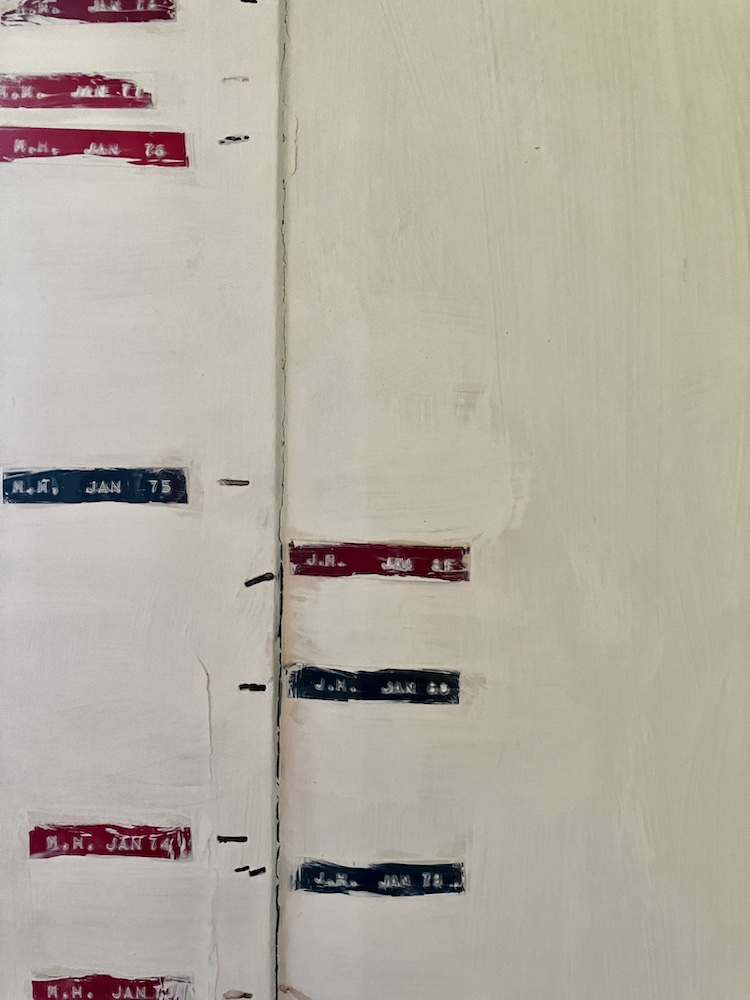
But here among the genuine clutter of a life coming to an end, I find things are not as gentle as the writers of self-help books might suggest. The dymo plastic labels my dad printed and stuck to the pantry door to indicate our heights as children: M.H. Jan 74. A pot of raspberry jam – perhaps the last my mother made, now inedible and changed from ruby to topaz because I couldn’t ever quite bear to open it. And a set of faded blue plastic pastry cutters bought in the 1960s (actually, maybe the 50s) and used for innumerable scones.
Grief has its unexpected triggers. And so does anticipatory grief. I will chuck the jam and the cracked china jugs and the broken steamer. I will make up a box of things for the charity shops including the teapot that may never actually have been used and most of those metal sieves. But somehow the pastry cutters found their way back into a drawer.
I’ll deal with them later.
* A Scots word meaning Rubbish Dump.
Very poignant, Michael, and so true.
At long last, I am facing up to years of hoarding. (Horrid word, but how else can I describe holding on to things, and not throwing them away?)
They have become a burden, mentally and physically, and I have started the (long) job of decluttering my house and my brain.
Good luck Michael, and thanks for sharing this so honestly.
Jenny x
Thank you Jenny! And good luck.