The Silent Teachers

In 2018 the University of Dundee celebrated the 130-year anniversary of the Cox Chair of Anatomy. I recently attended the launch of a book written to commemorate this significant milestone.

Entitled “To Bodies Gone”, the book by Edward Small (creative writing teacher at the university and a good friend of mine) charts the ups and downs of the anatomy department in Dundee. There was a time when it seemed that anatomy might disappear as a subject in its own right. But the reorganization that pushed Life Sciences to prominence in Dundee gave anatomy a lifeline. And that was compounded by the arrival of Sue Black.

Sue came with a background in forensic human identification. She also brought boundless energy and a huge talent for problem solving and team building. And so she took the department in a new direction. Today it is called CAHID – the Centre for Anatomy and Human Identification. CAHID has established an enviable international reputation for research and teaching.

One of the innovations that Professor Black championed was the use of a new technique called Thiel embalming. The donation of bodies by selfless individuals has been the bedrock of teaching anatomy throughout the 130 years of the subject at Dundee. And CAHID continues to believe in the vital role of these “silent teachers”. There has been no attempt to replace actual dissection with more “screen-based” instruction.

But the Thiel process results in far greater flexibility of the embalmed body than older techniques could provide. In turn, that improves the experience for students. And significantly, it also leads to new opportunities for research.

I have a special interest in this because my father is one of those “silent teachers”. Two years after his death, he is still helping medical teaching and medical research. We are all proud of that legacy.

For more information about body donation, contact the University of Dundee.

Last of the Urquharts

Recently I wrote about my experience of dealing with the funeral of my father’s cousin down south. Betty lived for many years in Farnborough, latterly in a care home. Her funeral took place in Aldershot Crematorium.

But she was a Falkirk bairn and had requested that her ashes be brought back to Scotland and buried in the Urquhart family plot in Camelon Cemetery.

I held power of attorney for Betty in her later years and among all her papers I found the original receipt for purchase of the lair. Betty’s father, George Urquhart bought the lease back in 1920 for the sum of three pounds and three shillings!

So I had no trouble in requesting an interment of ashes from Falkirk Bereavement Services. They just needed that proof of ownership and a cremation certificate.

On the day, I set off from Dundee with my mother. We’re both from Falkirk ourselves so it always feels like returning when we go there. And especially as we drove down Heugh Street where Betty was born and brought up.

It was very cold that day – quite frosty – but crisp and sunny. There were a few other relatives in attendance and we just held a short ceremony by the grave. But it was very beautiful in the cemetery with all the fine wintry trees. And moving to know that George had bought that plot exactly ninety-nine years ago to the day for his family.

Afterwards we all went for a lunch in a restaurant on the site of the old Rosebank distillery – a place that held a lot of significance for our family. It was a solemn and strangely peaceful day.

Betty was the last of her branch of the Urquhart family. And so our little ceremony on that winter’s day in Falkirk drew the story of their lives to a quiet and dignified close.

HMS Unicorn

Another historic venue with very personal significance to me

Almost exactly two years ago, I conducted a memorial service for my father. This was before I started working professionally as a celebrant – before I even trained.

But dad had donated his body to medical research. That means no funeral. (Even now, two years later, the university is still using his body for research – something that he would have been very proud of.)

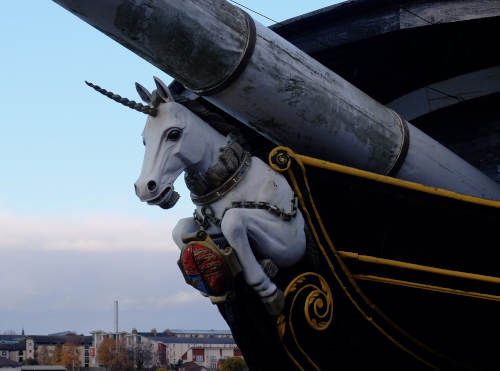
HMS Unicorn, Dundee

That’s difficult for the family though. We all need rituals, closure. And so we organized a memorial service in place of a funeral. Dad had been a seafarer all his working life and had worked briefly for Dundee Harbour. So a “naval” venue seemed appropriate. Since we’d already held a 70th birthday party for him onboard HMS Unicorn, that was the obvious place to celebrate and honour his life.

The frigate Unicorn was launched in 1824, making it one of the oldest ships still afloat anywhere in the world. Today it is both a fascinating museum and an incredibly atmospheric venue for all sorts of events.

Of course, being such a historic ship does mean that some things are a little more tricky…. access can be a problem. But at dad’s memorial, even with a large contingent of elderly sailors, we experienced no problems at all.

If you would like to know how we organized and conducted the service, don’t hesitate to contact me. Or speak to the Unicorn directly:

Lucy Richardson, Events Officer, HMS Unicorn 01382 200900 lucy@hmsunicorn.org.uk.

To Absent Friends 1-7 November 2019

The 2019 To Absent Friends festival was launched on 31 October at the University of Dundee. As part of the festival (organized by good life, good death, good grief) I highlighted a poem and a story in memory of my sister Katie and my father.

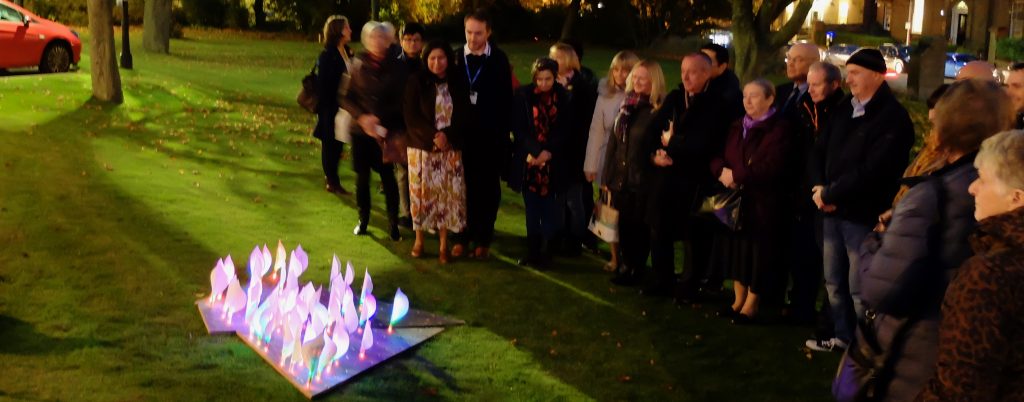
lily garden to absent friends
Lily garden for To Absent Friends Festival, University of Dundee

The festival is now over – I didn’t take part in any other events this year but maybe next year hope to be more active. Leave me a message if you’d like to help organize something in Dundee or nearby next November.

Meeting Neil Dorward, Pioneer Civil Celebrant

It’s about a year since I trained as a celebrant. So I thought it would be good to catch up with Neil and Annie who ran the course.

I’ve been working professionally as a celebrant for eight months. Meanwhile, Neil and Annie are now married – so a busy year for us all!

We got together for a coffee while Neil and Annie were in Dundee visiting family. Neil was one of the first people in Scotland to practise as a civil celebrant. Not religious, not humanist, but able to incorporate whatever elements a family might request. So, as something of a pioneer, he has watched the movement develop and grow.

I asked him what changes he had observed over this time.

Firstly, he sees more attention being placed on families and their needs. The family can be more involved in planning the funeral service.

And this is a profession in its own right. Unlike a priest or a minister who will have many duties to perform, celebrants can usually spend more time with families and more time writing and preparing their eulogies and services. Because that’s what we do.

Celebrants are trained not just to listen, but to practise “active listening”, specifically in the context of a bereaved and grieving family gathering.

What’s more, Neil feels that standards of delivery, enunciation, “performance” have risen. And all of this means better funerals, which is not just better for the grieving family but for the wider society.

People are maybe reacting to the rather clinical and inevitably hurried service so common in crematoriums and looking for something a bit more personal that still reflects the solemnity of the moment. (We talked about the fascinating Grayson Perry TV series on Rites of Passage.)

And the future? Well, Neil and Annie believe that these trends will only continue and opportunities for celebrants will grow. Interesting times for the development of the Scottish funeral!

Many thanks to Annie and Neil for your time and all your support over the last year!

Myres Castle

First in an occasional series of profiles of interesting alternative venues for funerals and memorials in the Dundee and Fife areas

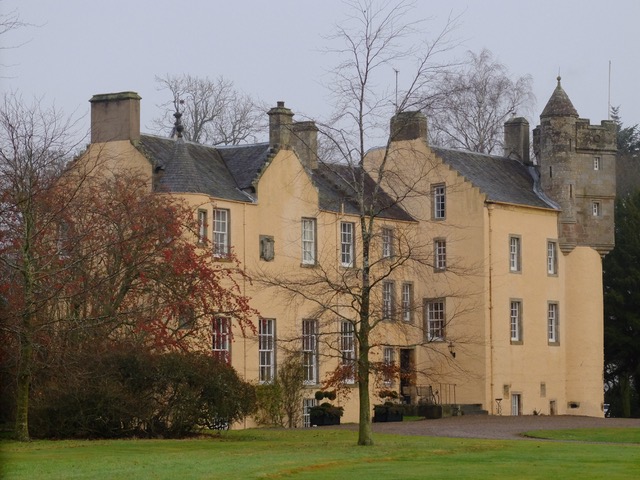
Myres Castle Auchtermuchty
Myres Castle, Auchtermuchty

I first encountered Myres Castle in January 2019 when I attended a writers’ retreat there. It felt like an incredible privilege to spend time in such beautiful surrounding.

At that point, I was still planning the launch of my career as an independent funeral celebrant. So inevitably, that came up in conversation. And, since one of my interests is holding services in different sorts of places, I did wonder if Myres Castle might be interested in hosting memorial services.

In fact, the castle already is a highly successful wedding venue. And they also host writers’ and yoga classes and retreats.

So I drove over to Auchtermuchty last week to chat to owners, Amanda and Henry Barge. This was the third time I’d visited – the first was the retreat in the dead of winter. Then I came for coffee in spring when the carpets of daffodils are legendary. And now I was there on a golden October morning.

It’s very clear that weddings are the main business of the castle and the Barges have established an enviable reputation. But, of course, weddings are mainly held in spring or summer and almost always at weekends.

So Amanda and Henry would be very open to chatting about the possibility of hosting memorial services or funerals. And it really is a wonderful location. The castle itself with its history and sense of tradition, the beautiful gardens and grounds, and the more modern Applestore and Barnquee where currently the ceremonies take place – a perfect blend of solemnity and informality.

If you would like to know more, contact me or contact Myres Castle directly:

Myres Castle, Auchtermuchty, Fife, Scotland KY14 7EW
Phone: +44 (0) 1337 828350 Email: enquiries@myrescastle.co.uk

Creating a place of reverence

Just a golf club and a table tennis racket placed at the foot of a coffin.

Let’s be honest, crematoriums are not attractive places. Sometimes corporate, sometimes municipal – and usually, in a clumsy way, trying to be a “chapel”. (There are honourable exceptions, Friockheim.)

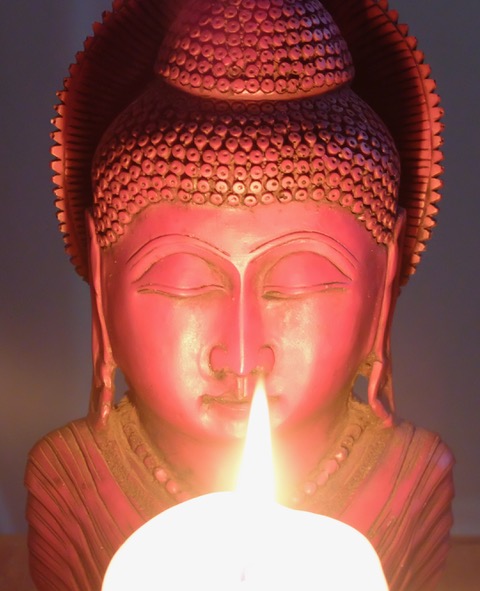
Buddha and candle

And, the pressure of schedules is always there, squeezing the ceremony into a twenty-minute straitjacket.

But it is possible to bring reverence into the proceeding. A well crafted eulogy, a sense of dignified ceremony. And sometimes a few touches can help transform the space. Like a naval flag, British Legion standard bearers and a bugler. Or a brass Buddha and three tea light candles. Roses placed on the coffin.

And today it was a golf club and a racket placed at the foot of the coffin.

One year on….

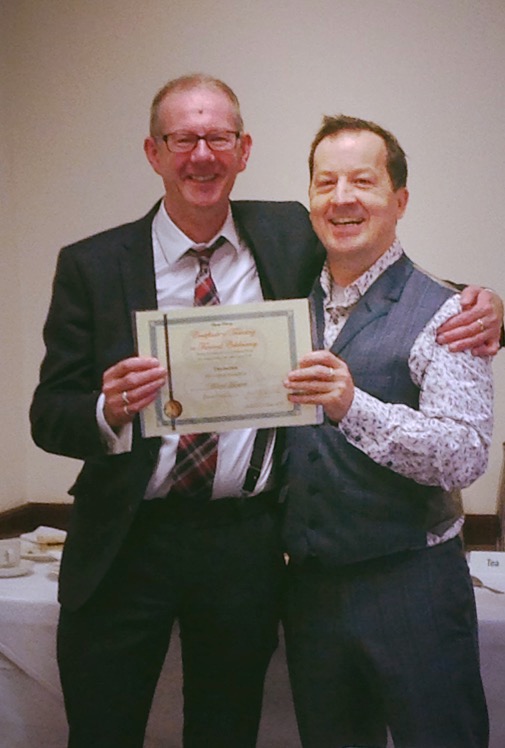
It was exactly a year ago that I started Neil Dorward’s Training in Funeral Celebrancy course.

It’s been quite an amazing year for me. First of all I found the course incredibly stimulating and valuable. It helped persuade me that this was something I wanted to do and something I might have a talent for.

Michael Hannah and Neil Dorward, Celebrants
Neil Dorward & Michael Hannah

Then I took the decision to resign from the University of Dundee and plan my new career as a celebrant.

It was hard work getting all my university projects into a state where I could hand them over. Plus, I felt wracked with doubts about what I was planning to do.

“Will I find work?” “Can I write a decent eulogy?” “How will I react when I visit grieving families?”…

Well, it’s been the proverbial “bumpy ride” but I’m still here. And I’ve conducted a wide range of services – different types and different places. I’ve made some really strong connections with funeral directors. I’ve had some very positive feedback. And I’ve learned so much about this work.

So even though I’m not quite where I need to be yet, I’m pleased and proud of what I’ve achieved so far.

Today I met up with two of the other people who did that course a year ago with me. We’re all at different stages but it was so good to catch up over a coffee and recognize that one of the best things about it was meeting the other wonderful people on the course.

Being a funeral celebrant is a vocation – I’m looking forward to testing that calling over the next year.

The other side of the coin

I’ve now been practising as an independent funeral celebrant for over seven months. I’ve gained a huge amount of experience in that short time and conducted a wide range of services.

I’ve also gained a lot of insight into grief and bereavement and the emotional, financial and practical strains that accompany a death in the family.

But in September, I faced a bereavement of my own. My late father’s cousin died in her care home in England at the age of 92. Betty had been more like a sister than a cousin to my dad so I thought of her as an aunt.

Betty never married and had no children of her own so maybe it was natural that she would choose me to act as Power of Attorney when she was putting her affairs in order in 1999. Back then, she was completely healthy and signing that document meant very little to me at the time.

Then five years ago, after a fall and a stay in hospital, it became clear that Betty’s memory was beginning to fail. Suddenly we found that we had to register those documents and I had to take over all her day-to-day affairs, from paying the gas bill to finding a suitable care home.

So her death came with a lot of mixed emotions. On the one hand, I knew that life hadn’t been easy for her latterly – she was always a very independent woman so being in a home and contending with dementia must have been a terrible struggle for her. Maybe death came as a release. 

But I still felt great sadness at the loss of another member of my dwindling family. The loss of someone who had been close to my father. And the loss of someone I had responsibility for during these past five years and had come to know so much better and grown closer to. 

There are also all the practical problems. How do you register the death of someone at a distance of 500 miles and in a different country? How do you choose a funeral director? What exactly does “Power of Attorney” mean once someone dies? What kind of funeral service do you organize….. and how do you pay for it? I now understand better what funeral directors do to make the whole process run smoothly but it’s still a shock to see their bill in black and white.

In the end, everything works itself out. The care home were patient and helped me with the bureaucracy of registration (though it took them two trips to the Registrar because I didn’t provide all the information they needed the first time).

I had already sounded out funeral directors when Betty’s health started to decline and the people I chose (Ford Mears of Farnborough) turned out to be immensely helpful – and the executors calmly handled the bill.

And then there was seven months of experience in conducting funerals to help me plan this one. 

It’s not easy to walk into a strange crematorium (Aldershot in this case) and deliver a service but the staff showed me round and the only tricky technical issue was that at Aldershot it’s the celebrant’s job to operate the music – well, we nearly had Morning has Broken twice but I mostly managed OK!

It’s been a stressful few weeks and a time of sadness for me but I’ve also learned so much about what this experience is like from the perspective of the bereaved and that will hopefully help me be a more understanding celebrant in future.

Pathfinders Dublin

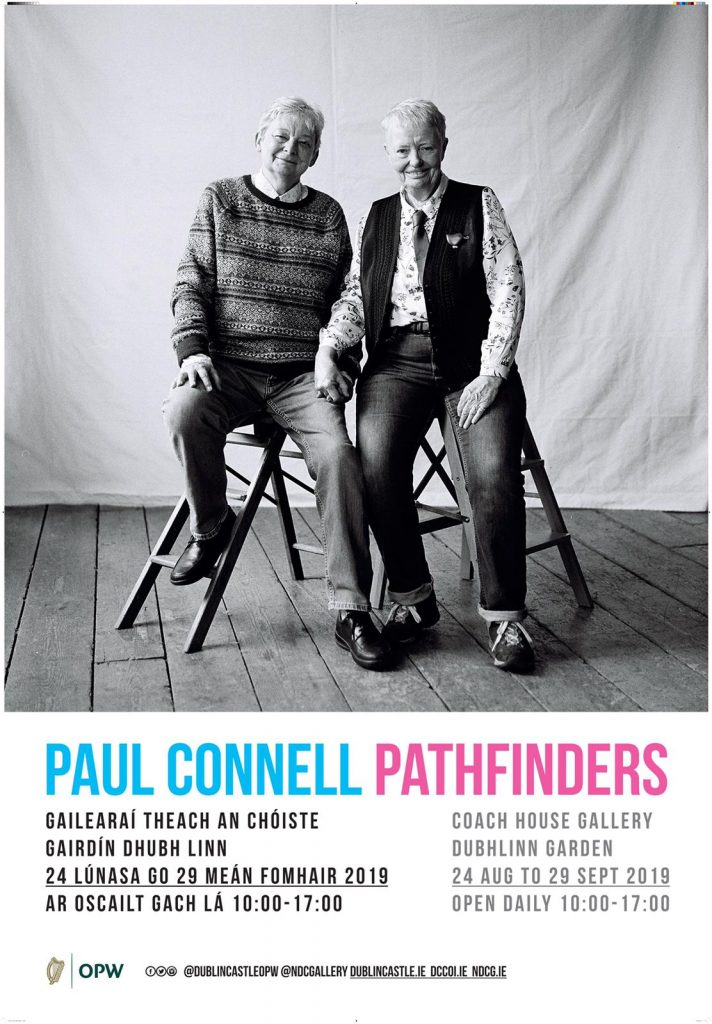
I’m just home after a couple of days in Dublin. I went over for the opening of a photographic exhibition by one of my oldest and dearest friends, Paul Connell.

Pathfinders photographic portrait exhibition of older LGBT people in Ireland by Paul Connell

The exhibition is called Pathfinders and it’s a series of portraits of older men and women who were involved in the struggle for equality and rights of LGBT people in Ireland. Some of these were activists with a high public profile. Most were simply people who lived their lives quietly but openly and with integrity. Brave rebel hearts!

A key element of the portraits is that all are shot in exactly the same way: same backdrop, same stepladder, same camera, same lighting. It’s a democratic approach that places all the focus on the person and their character. And taken together, the collection becomes a nationally important archive.

Paul and I have been close friends for many years and there’s always been a sense of our lives running in parallel. As I approach my 60th birthday I feel that, by becoming a funeral celebrant, I am finally doing something truly fulfilling. Paul’s been a photographer for years but the Pathfinders exhibition, held in historic Dublin Castle and opened by the Irish Minister of Culture, Josepha Madigan, marks national recognition for his skill, artistry and vision.

And in our different ways, both our work seeks to celebrate the essence of a person’s life.

Thank you, Paul, for your friendship and support through more than thirty years.

Meeting funeral directors

It’s nearly five months now since I visited my first funeral director as a new celebrant. That was very scary. It’s hard to walk in off the street and introduce yourself “cold”. Especially if you’re not great at selling yourself.

But when I met Andrea Baker at Gibson of Tayport today, I had the advantage of a body of experience behind me. I was able to speak about my style and approach knowing that I had real examples and wasn’t just speaking in the abstract.

But in fact I needn’t have worried. Andrea was welcoming and genuinely interested in what I had to say. She’s now the owner of Gibsons having taken over from David Gibson, whose father William started the business back in 1972. (Though I understand that David still contributes with his experience and wisdom.)

We chatted over a cup of tea and spoke a lot about how we try to tailor our services as closely as possible to the family’s needs. A bespoke service.

And we discussed how we like to be able to offer different sorts of venues and ceremonies. And even to work with people who are looking ahead and wanting to plan their own funerals.

A really good conversation and I hope we can work together to realize some of these ideas.

An occasional blog

This is just a place where I can write down my thoughts of becoming a funeral celebrant, independent celebrant, civil celebrant…. whatever.

It’s been quite a process since I left the Clinical Trials Unit at Dundee University back in February this year. I’ve learned so much and met so many people. And overwhelmingly it’s been a positive process.

So hopefully this will be a place where I can record some thoughts and observations of this new career.